
An easy answer would be that it is a place where old instruments and rare objects are displayed. For decades, that was precisely the approach adopted by many museums devoted to music: violins with violins, flutes with flutes, keyboards with keyboards, organised according to the way they produce sound. A useful classification for musicologists, perhaps, but one that tells visitors little about what really matters: why do we make music? That is the question that guides the new exhibition journey at the Royal Building of Mafra.
.jpg)
The move of the National Music Museum to Mafra was more than a change of address. It was an opportunity to reinvent the museum itself.
For more than thirty years, the collection remained in temporary premises at Alto dos Moinhos. Before that came a succession of projects that never materialised, with Évora, Oporto and various locations in Lisbon all considered as possible destinations. The move to Mafra finally brought a long period of uncertainty to an end, while breathing new life into spaces within the Royal Building that had long awaited a new purpose.
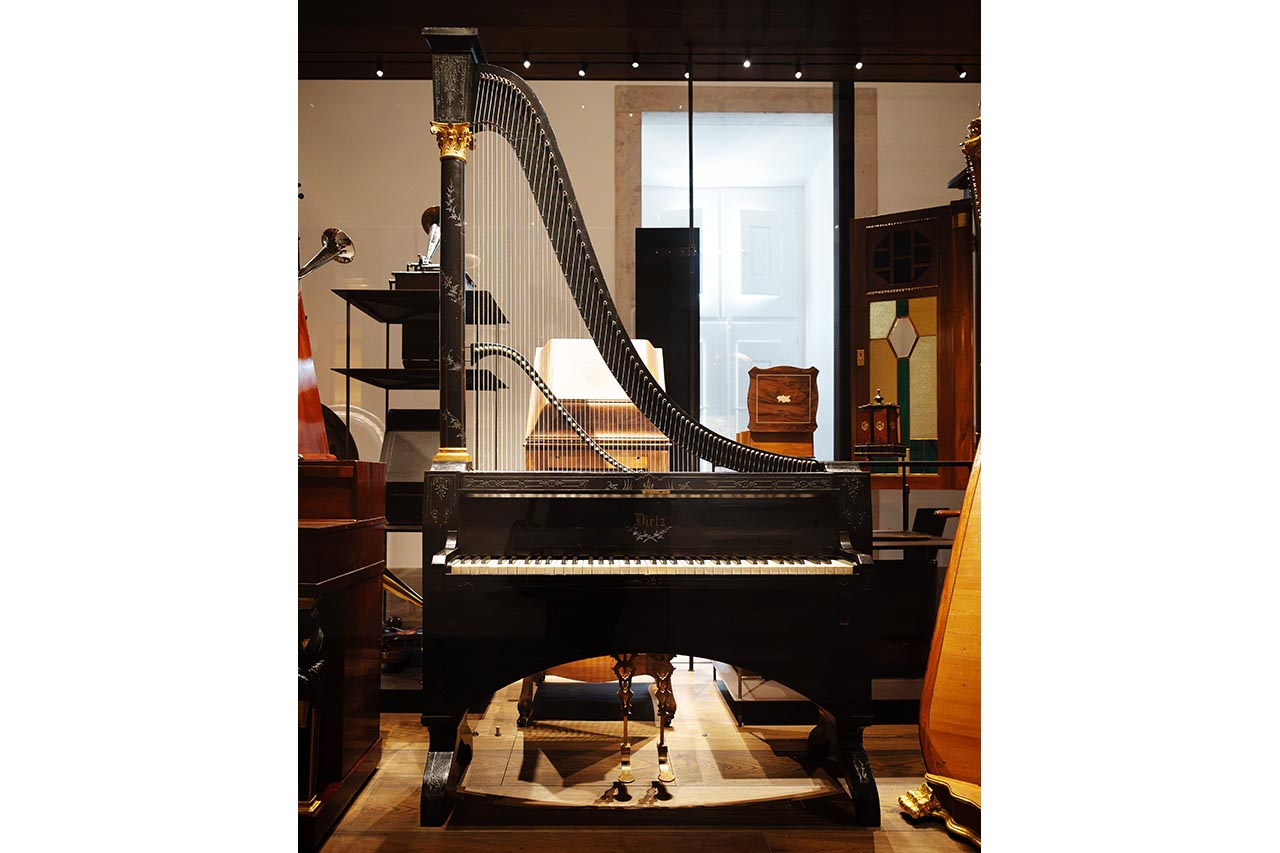
But restoring the building was only half the challenge. The collection itself also needed restoration. Around five hundred pieces underwent conservation work before going on display. Some yielded unexpected surprises. A piano believed for decades to be black revealed an unexpected shade of green once successive layers of aged shellac had been removed. Small discoveries such as this remind us that museums preserve more than objects; they also preserve stories that remain hidden until someone brings them back to light.
That sense of discovery accompanies us throughout the exhibition. Rather than taking visitors through a chronological history of musical instruments, the museum chooses to organise itself around larger questions. The first is inevitable: what, after all, is music?
One display case contains objects we would hardly expect to find in a music museum: a referee’s whistle, a car horn, a crystal glass, a bell, a saw, a hunting horn. None seems naturally to belong in this world. Yet all can produce sound and all, under certain circumstances, can become musical instruments.
The provocation is deliberate. Music does not necessarily reside in the object, but in the relationship we establish with it. Visitors are invited to abandon the idea that there is a rigid boundary between sound and music. What turns a sonic phenomenon into music may depend as much on the act of listening as on whatever produces the sound.
It is a subtle shift in perspective, but a decisive one. The instrument ceases to be the protagonist and listening takes its place.
That idea reaches its fullest expression in one of the museum’s most unexpected rooms. Paradoxically, it contains almost no instruments. Instead, there is an immersive sound system comprising twenty-four speakers, vibrating platforms, projections and an interactive installation that allows visitors literally to manipulate the soundscape. Rather than contemplating objects, they experience the phenomenon of hearing itself.
Here too, the museum avoids closed answers. Some people cross the room in a few minutes. Others remain seated, simply listening. The space was designed precisely to allow for these different ways of experiencing it.
From this point onwards, the exhibition stops asking what music is and begins to ask why we make it.
The answers unfold through a succession of thematic sections. One room is devoted to folk traditions, where instruments from Madeira, Croatia, Catalonia, Austria, Mozambique and China stand side by side. Their proximity has nothing to do with geography or the period in which they were made. It comes from the role they play. All are part of festivals, celebrations, pilgrimages or community gatherings. What brings them together is not their origin, but the way they accompany fundamental moments of collective life.
In another room, devoted to the transcendent, music appears in connection with beliefs, rituals and mythical narratives. Instruments associated with legends share the space with objects used in the religious practices of different traditions. An old square piano conceals beneath its soundboard a small devotional engraving placed there by the maker himself — invisible to anyone playing the instrument, yet revealing of the intimate relationship between craftsmanship and the spiritual dimension that so often accompanied it.
Perhaps one of the most curious episodes in the exhibition is devoted to the celebrated Florentine forger Leopoldo Franciolini.
Rather than conceal the deception, the museum turns it into an opportunity to explain how authenticity is constructed. Franciolini made imaginary instruments, frequently using genuinely old components. In one of the examples on display, recent conservation work revealed that some of the pieces used by the forger were actually older than he himself had realised. The fraud, as it turns out, contains an unexpected fragment of truth.
Few museums could resist the temptation to present this story merely as a curiosity. Here, it serves to show how objects acquire complex biographies, built up through successive layers of use, transformation and interpretation.
One idea recurs throughout the exhibition. The instruments are not presented as isolated masterpieces, but as witnesses to human activities: celebrating, learning, praying, exercising power, constructing identity, building community. Each room explores one of these dimensions, refusing to separate objects from different cultures or periods whenever they have played similar roles in people’s lives.
For the same reason, technology is more than simply an aid to the visit. A headphone system accompanies visitors through one of the galleries, automatically activating the sounds of the instruments before them. Suddenly, the display cases are no longer silent. The museum restores what is normally lost when an instrument moves from the stage into a museum: its voice.
By the end of the visit, we realise that the true protagonists were never the objects, but the people. The people who made the instruments, those who played them, those who collected and restored them — even those who forged them.
And finally, the people who enter the museum today and are invited not merely to observe a collection, but to participate in it — whether by suggesting music for a collective playlist or by discovering, at their own pace, new ways of listening.
The National Music Museum does not merely ask us to look at its instruments: above all, it invites us to listen to the questions they continue to ask.
.jpg)
.jpg)
.jpg)
.jpg)
.jpg)
.jpg)
.jpg)
.jpg)
.jpg)
.jpg)
.jpg)
.jpg)
.jpg)
.jpg)